
Black Madonna For President


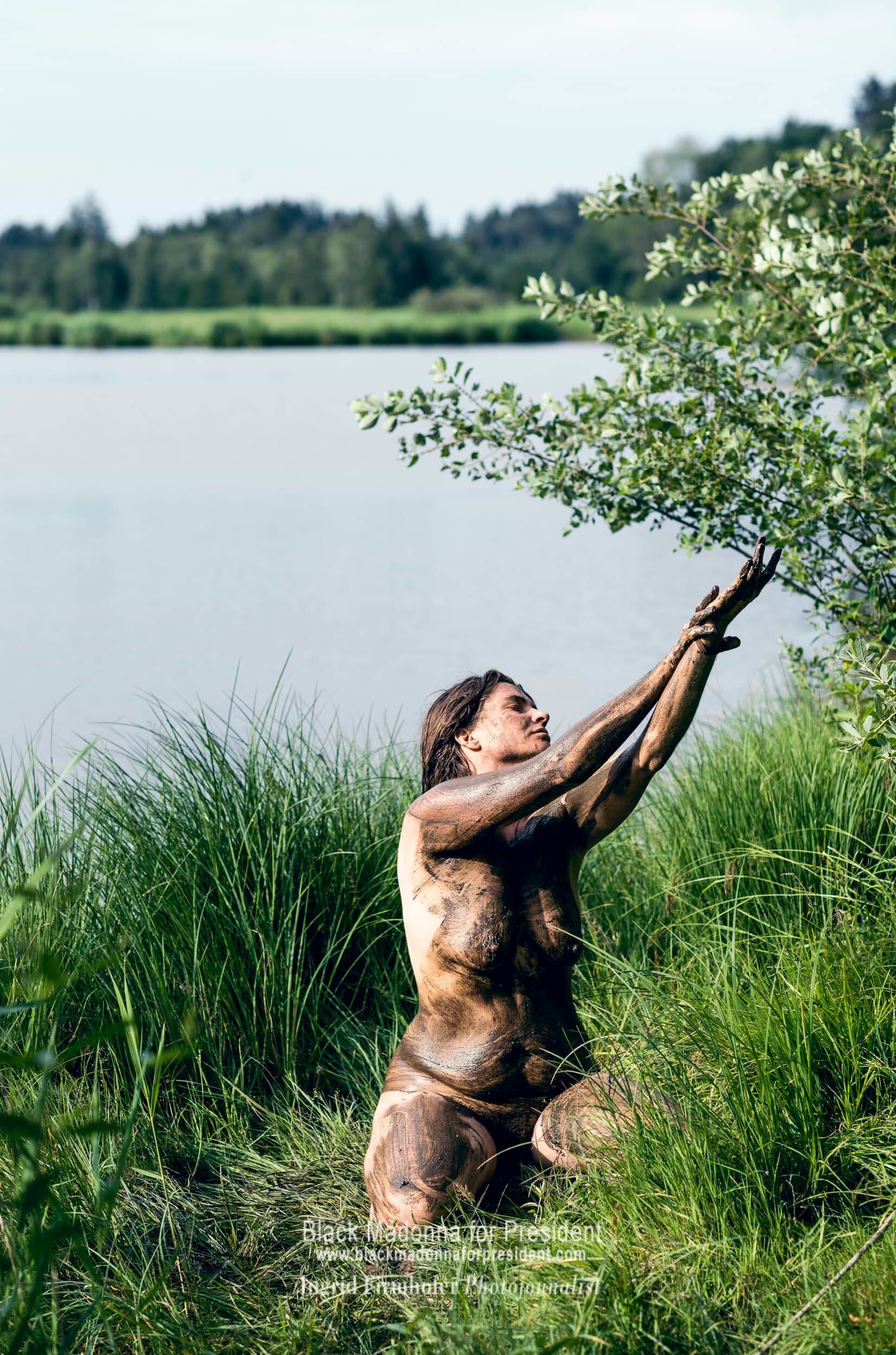
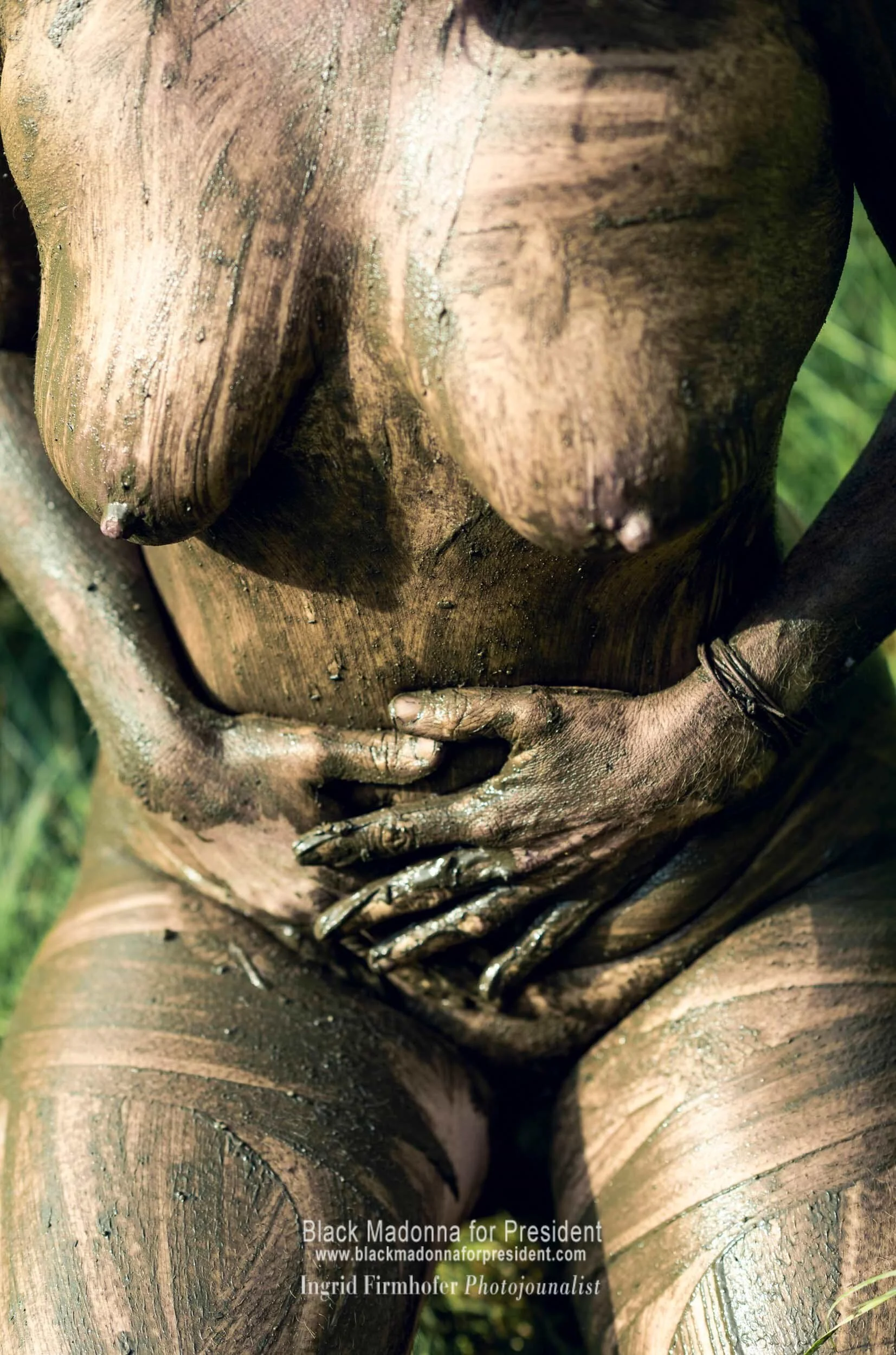


Photo- and Textproject
Black Madonna for President
What does it mean to be a complete woman?
1.4 Agreements between Photographed Women and Photographers
2 How do I achieve this through photos and text?
2.2 Text accompanying the Image
2.3 Project Title, Main Text and Name of the Website on Each Image
3 Sexuality is a Main Focus of the Project
3.1 Sexuality is missing in spiritual groups
3.2 Capitalism, Sexism and Racism
4 Sex positive feminism and why we owe its spread to black women
5 Where does the Black Madonna come from and what does it mean?

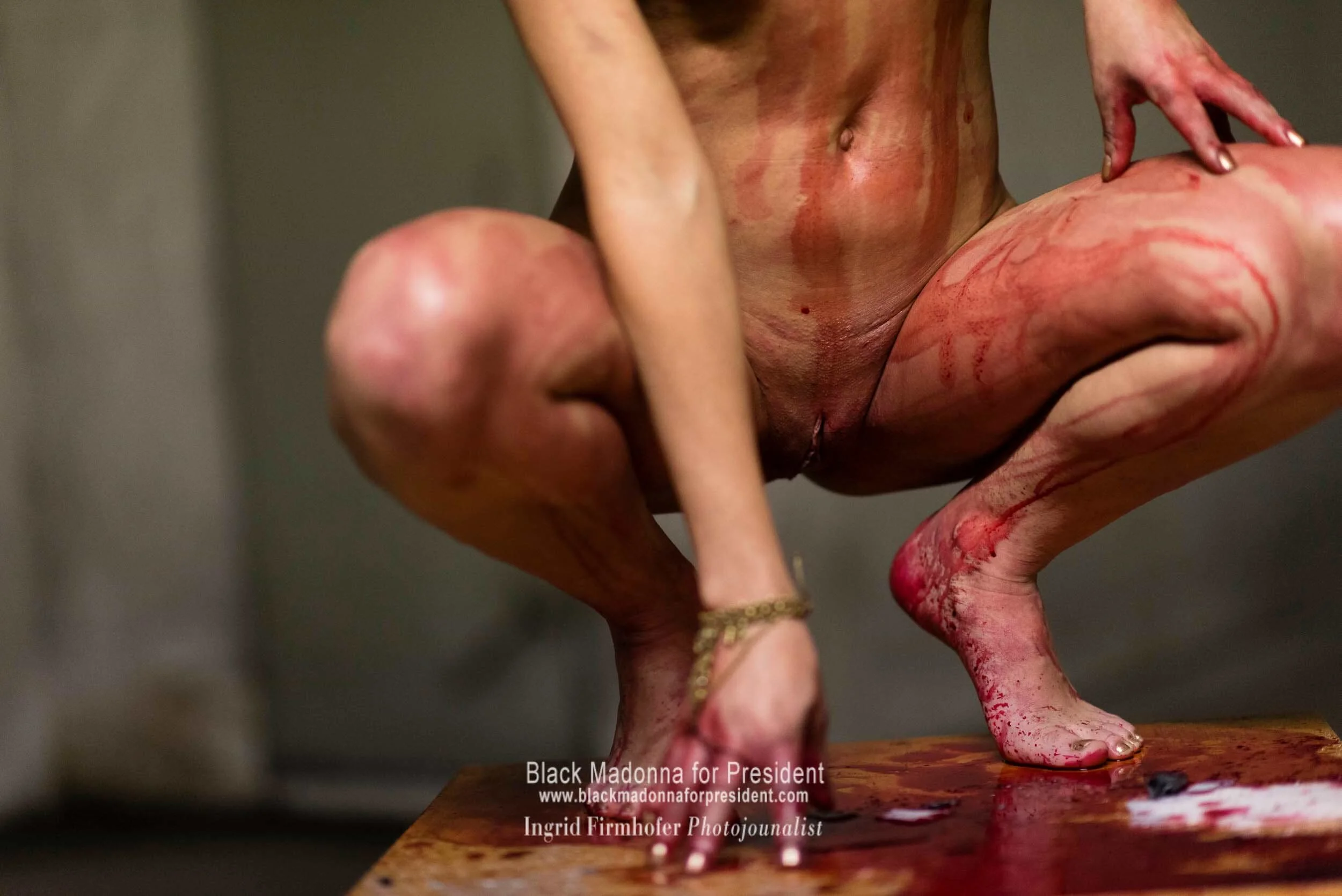


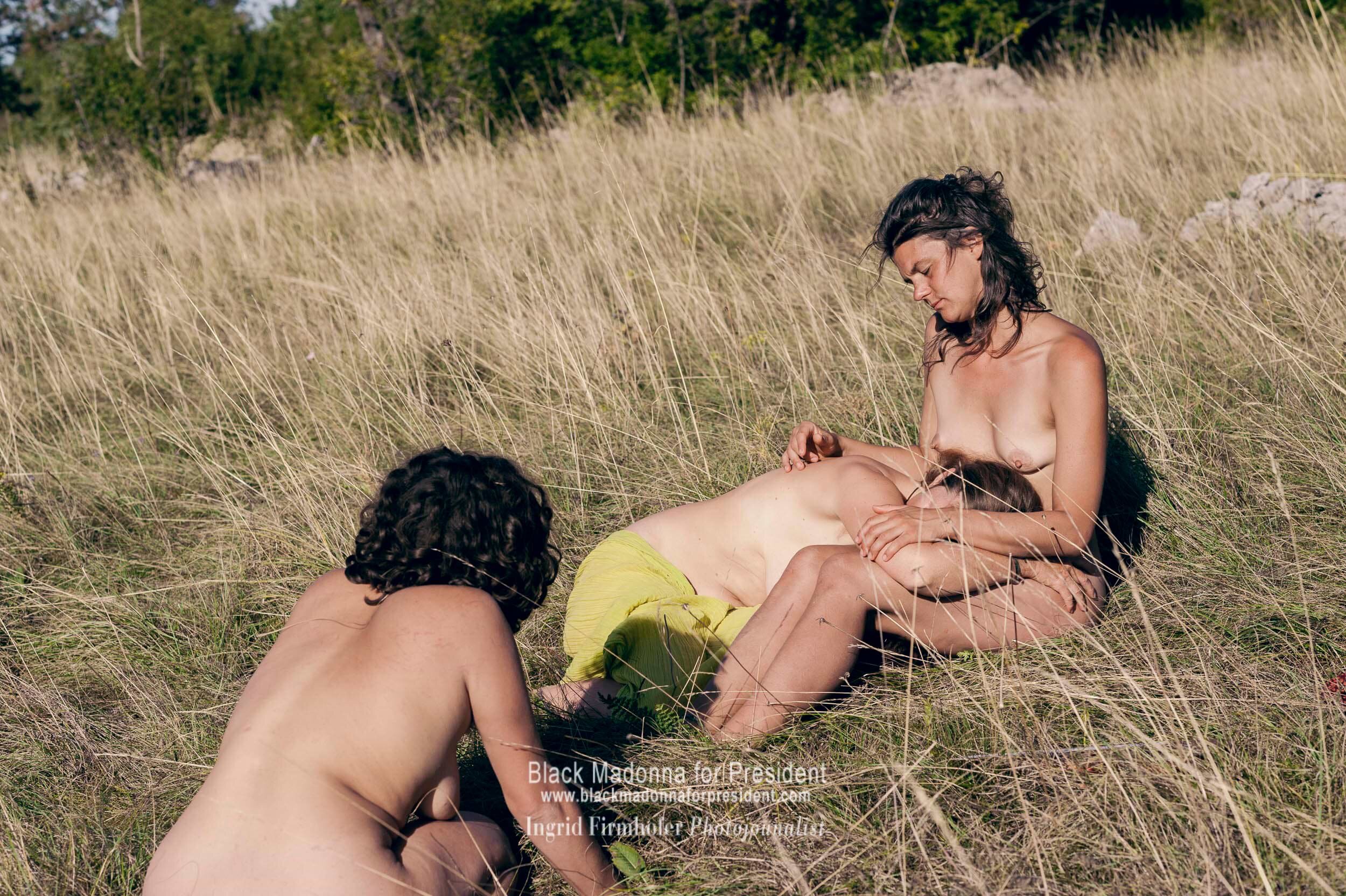


A Note on the Evolution of this Project
When I started Black Madonna for President, I used the archetype of Isis as a symbol of female power. Today, I see things differently. To me, Isis is no longer a symbol of female empowerment. The opposite is true. I simply didn't know her full story back then—a story that is the ultimate product of patriarchal mind-fuckery and a precursor to Transhumanism.
Isis conceived Horus solely through the power of magic. Her husband’s penis was lost, and she decided she didn’t need that "unimportant biological detail." I actually love that I discovered this connection, because in my text, I mention Zeus and how he didn't need the biological female sex to give birth to Aphrodite. Isis is just as patriarchal as Zeus. It’s the same denial of nature—maybe this way, even men will finally get it.
It is not about Goddess against God; it is about Mind-Magic against Nature.
1 Project Description
1.1 The Aims of the Project
A somewhat simple but very common definition of feminism is "equality between men and women". But we don't want to be equal to men. We want
to express traits traditionally labeled as masculine like anger without being called hysterical or furious, or assertiveness and ferocity without being classified as too masculine,
the female values (Yin) to be appreciated again: sensuality, devotion, vulnerability, intuition, connection, and the wisdom that comes with age;
eroticism to be seen as a sacred source of creation and creativity that takes place when Yin and Yang meet.
Connection means the inter-connectedness of everything: to nature, to men, to oneself, and to one's own feelings within the body. Capitalism separates and utilizes racism and sexism. Eroticism is covered with the most toxic shame—the internalized shame that rots within us. This project creates awareness of this toxic shame, and I devote it especially to the women affected by both racism and sexism to whom we owe sex-positive feminism: Black female dancehall and Hip Hop artists.
1.2 Project Character
This is a photo- and text-project. I show the photos on my website and on social media. There, I show the women's photos and their statements in text form on or next to the photos. In addition, I explain my idea behind the project in my own text. I don't want to commit myself to a certain style because I want to develop and grow in every direction. I want to use both digital and analogue photography. I may retouch, but not to change the body of the participants.
1.3 Timeline and Participants
I started taking photos for this project in March 2017. Between then and July 2020, I photographed 100 women. As the project evolved, my focus shifted toward involving women who do not correspond to the patriarchal norm of beauty. I looked for women who defy the ideals presented by the advertising industry: women who are comfortable with their "bacon rolls" and women with hair on their legs and under their armpits.
I sought out women who do not confuse being angry with being ugly or hysterical; women who are proud of their sensuality and eroticism; and women who feel erotic in old age or with physical limitations. I looked for challenging and wild women of any skin color, as well as those who are vulnerable and soft. This project includes women who are not ashamed of their spirituality, mothers who are not ashamed to breastfeed in public, and sexually self-determined women who do not ask a man—neither their husband nor their boss—for permission to exist as they are.
2 How do I achieve these Goals through photos and text?
2.1 Photos
These photographs are a tool for self-acceptance and liberation. Instead of words, the women express their wildness, sensuality, and spirituality by treating their bodies as art. In a safe and sacred space, their inner consciousness becomes visible. We do not show these images to seek external validation, but as a voluntary act of self-determination. The dignity within the images shows that we are not objects, but holistic beings.
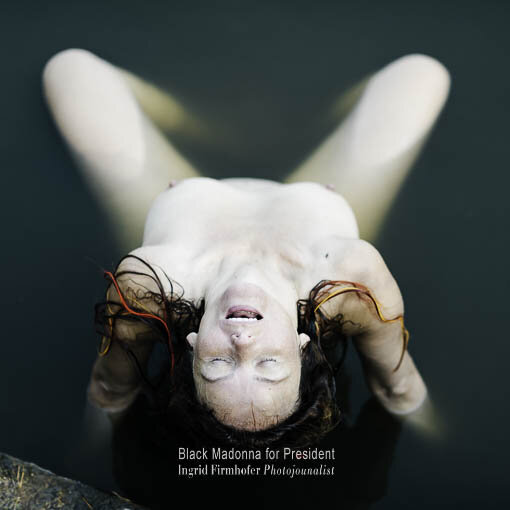
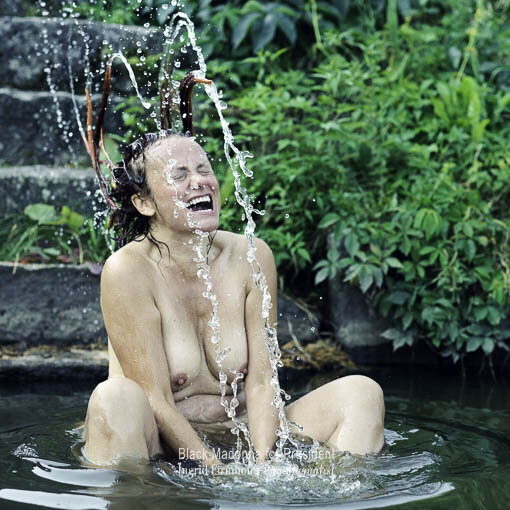
2.2 Name and profession
The more information provided, the freer the women appear to be. I heard several times from women who could not participate for professional reasons or because their husbands were against it. The omission of this information provides insight into how free we actually are in our society. It is understandable for a woman not to give her full name if her contact information could be found on the internet and she does not want to be harassed.
2.3 Text accompanying the image and the concept of direct action
The text upon each picture is not about what we do NOT want or what we are NOT. It is about what we want, and what our visions are. The nature and length of the text were free, provided they were short enough to fit onto a photo. The project is not a protest; it is direct action: acting as if you were already free.
3 Sexuality is a Main Focus of the Project
I find all the above-mentioned aspects—sensuality, devotion, vulnerability, intuition, age, and wisdom—equally important. Nevertheless, I have placed a special focus on sexuality for two main reasons:
3.1 Beyond Sensuality: The Wild and Demanding Power
Spiritual and Tantric groups have done important work in bringing awareness back to the body and honoring sensuality. However, a crucial element is still missing: the raw, wild, and demanding side of female energy. While many circles focus on "softness," this project embraces the fire as well. We reclaim the untamed power that has been suppressed—the part of the woman that is not just sensual, but fierce and uncompromising.
3.2 The Political Context: Capitalism, Sexism, and Racism
The second reason is that the suppression of sexuality was the primary tool used to establish patriarchal and capitalist control. To control property and labor, the system had to first control the female body.
The Fence Around the Woman
The suppression of women is inseparable from the concept of private property. It began when humanity started to treat land and nature as something to be "owned." As soon as land became property to be inherited, a man had to be certain of his biological paternity. To ensure his offspring would inherit, he had to control the woman’s body and restrict her sexual freedom. The fence around the field necessitated a "fence" around the woman. Anthropologist Mark Dyble, studying the Palanan Agta community, confirms that a high degree of sexual equality existed before the introduction of agriculture and land ownership [1].
The Body as a Factory
This control reached a violent new dimension during the transition to early capitalism. In the 14th century, the Black Death wiped out a third of the European population, leading to a massive shortage of labor. For the emerging economic system, this was a catastrophe. To fix it, the female body was redefined as a "factory for the production of workers" [2]. The Church, losing half of its peasants, was a driving force behind this [3]. Procreation was no longer a private choice; it became a public duty toward the state.
To enforce this, the state and the church launched a war against women: the witch hunts. This was a calculated strategy to destroy women's knowledge of birth control and healing [4]. By demonizing midwives and "wise women," they stripped us of the power over our own fertility.
The Colonization of Pleasure
The paradox—demanding children while banning pleasure—was the key to this trap. If a woman enjoys her sexuality, she remains the sovereign of her desire and her body. But by turning sex into a joyless "duty" and criminalizing pleasure, the state ensured that women lost the connection to their bodies [5]. Without pleasure and without the knowledge of herbs, pregnancies became "forced."
Birth out of wedlock became a felony—not because of the child, but because it was proof of sexual pleasure without the intent to produce "human capital" [6]. The most "shameful" woman was no longer just the prostitute, but the one who enjoyed her body without giving birth [7]. Even older women, past their reproductive years but still possessing their desire and wisdom, were targeted as the ultimate threat to be broken [8][9].
This was the moment deep, systemic shame was burned into the European soul. When people today look at the "stiff" and disconnected bodies of the Western world, they are seeing the long-term result of this historic terror. We were the first victims of this colonization of the body; our "stiffness" is the frozen echo of a centuries-long witch hunt [10][11].
Economic Imprisonment and Global Contrast
The Industrial Revolution completed this imprisonment. Production moved from the communal household to the factory, as machines replaced the vital crafts women had controlled for centuries—like weaving, soap-making, and textile production. Women could no longer produce their own means of survival; they were forced to buy what they once created, making them entirely dependent on the male wage.
Crucially, while European women were being reduced to domestic dependents, women in Africa and South America and other parts of the world often maintained their economic independence within the family household much longer. Even under the horrific conditions of slavery, Black women often retained a form of domestic equality and strength that the "civilized" European housewife had long lost. This was evident at the Akron women's meeting, where white women were too "domesticated" to stand up for themselves until Sojourner Truth, an emancipated enslaved woman, rescued the meeting with her powerful "Ain't I a Woman?" speech [12].
Divided Solidarity
It is essential to understand that the mechanisms of racism and sexism were used as tools to divide and conquer. It is a tragic irony that the early women’s rights movement in the US originally formed out of the struggle for the abolition of slavery; white and black women fought side by side for the liberation of Black people. However, when the system forced a choice—granting Black men the right to vote before women—the poison of racism took hold. Instead of maintaining solidarity, white Suffragettes turned to racism [15]. This break was exactly what the system intended: to keep oppressed groups fighting each other for the few rights that were granted.
The Only Exception: St. Jean-de-Luz
The history of the Great Witch Hunt is largely a history of silence and betrayal, as hardly any men dared to protect the women. The only documented example of a community of men defending their women as a collective occurred in St. Jean-de-Luz [14]. When the inquisitors arrived to snatch the women, the fishermen returned from the sea and stood as a wall to protect their community. They refused to let the "divide and conquer" strategy take hold. This unique case reminds us that our "stiffness" was never an inevitable fate—it was a political agenda that only succeeded because, in most places, the collective resistance was broken.
The Continuity of Terror
These historical patterns are not a thing of the past; they are still used today to maintain control over the "human machine." In the era of neoliberalism, we see a new wave of land grabbing in the global South, which often triggers modern witch hunts against women who resist their economic displacement—attacks that go almost entirely unmentioned in the international press [13].
4 Sex positive feminism and why we owe its spread to black women
That feminism has gradually become sex-positive feminism is due to the movement of black women who have had enough of being patronized by white women. They had had enough of a dry, joyless feminism, which interpreted their femininity and their wild sexuality in dance as an "objectification". As early as 1999, the African American academic Joan Morgan at Stanford University made it clear with her "Hip Hop Feminism" that feminism and a sexual pleasure on display are not mutually exclusive. There is no African dance that was not first accompanied by indignation and contempt from the white upper class, but then was gradually appropriated by them. Madonna makes no secret of the fact that her art is consciously inspired by other cultures and that she loves Afro-American culture. She also had to put up with a lot, but probably that's nothing compared to what black female hip-hop and dancehall musicians went through. Dancehall is a music style based on reggae with similarities to hip-hop.
Especially these genres are so aggressive, misogynist and homophobic that as a passionate reggae dancer, I turned my back to the dance when it was replaced by the dancehall and started drumming instead. Women are referred to in the songs as "bitches", "hoes" (whores) or "pussies". Violence against women seems normal and pimping is glorified.
The black women, however, grew up in this environment and did not let anyone spoil their fun with the music and their body. Morgan made it clear in her book "When Chickenheads Come Home to Roost - A Hip-Hop Feminist Breaks It Down” that there is not only black and white, but also grey. And this grey area contains the contradictions of
loving an art that does not accept you as belonging
loving men who sometimes refuse to portray you in your entirety
being against sexual objectification while proudly embracing your sexuality.
And as a self-defined feminist who grew up with hip-hop, she didn't mince words when she said, “And how come no one ever admits that part of the reason women love hip-hop – as sexist as it is – is ´cuz all that in-yo-face testosterone makes our nipples hard?”[16]
In the 80s the two hip-hop artists Salt-n-Pepa declared themselves feminists and the first female rap singer MC Lyte sang openly about her sexuality and her own magnificence. In the 1990s, the third wave of feminism brought the removal of sexual taboos into academic white circles. But how is it that, in the context of sex-positive feminism, the women who lived this feminism, fought hardest and made it accessible to the general public, are nowhere mentioned in this context? Female MCs such as Foxy Brown, Lauren Hill, Queen Latifah and Miss Elliott made clear statements about sexuality and discrimination against women. They were constantly accused of making themselves an object.
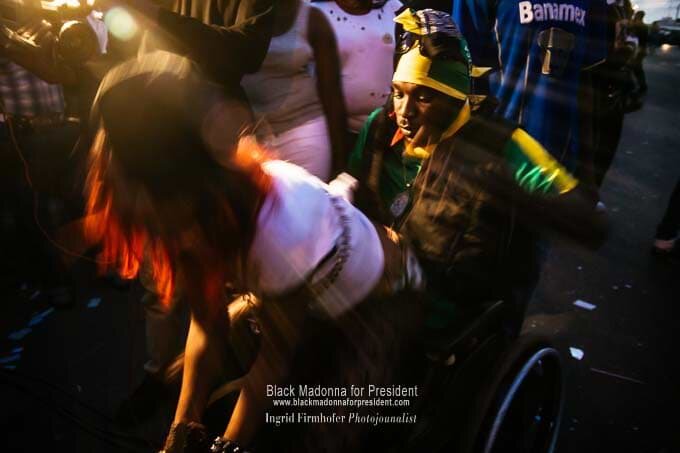
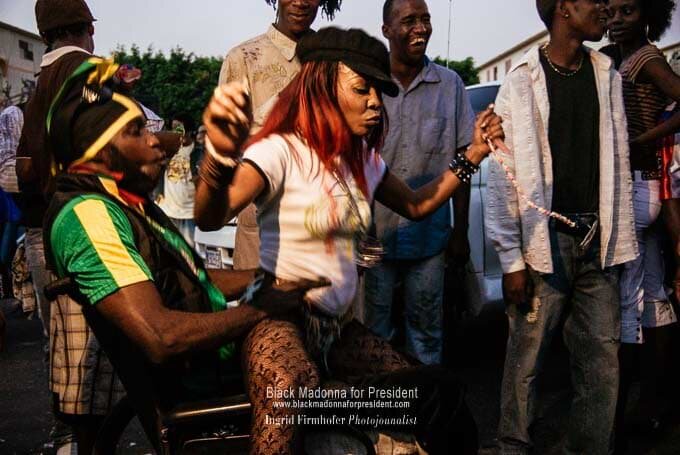
Currently, it is mainly the dance forms of twerking [17] and daggering (dry sex), which though considered vulgar, spread across the world from Jamaica in no time at all. My agency wouldn't accept the Passa Passa photos I made of this famous place in Kingston, the origin of dancehall, because they were "too vulgar".

Kingston Jamaica
Passa Passa
Basically, art forms such as dancehall and hip-hop portray in the most blatant form what is going on in the patriarchal world: abuse of all feminine values. It is precisely from this art form that the counter-movement to balance arises. Puerto Rican reggaeton singer Ivy Queen announced in 2003 in her song "Quiero Bailar" (I want to dance) that she loves to dance the perreo (dog) while sweating and rubbing her butt against her partner. But then it ends with the chorus "Eso no quiere decir que pa' la cama voy" (This does not mean that I go to bed with you).

Passa Passa, Kingston Jamaica
Daggering
She makes it clear that women can also enjoy their wildest sexuality in public, just as men do without losing possession of their bodies. I have seen similar forms of dance even from self-confident older women on my travels before. Not only did I see it, they literally took me by the hand and taught me how to move my hips without laughing at me. There are also enough examples of this on youtube, which shows that this is an old form of ritual dance. The Baikoko dance, for example, which is mainly danced in Tanzania and Kenya and the similarity to twerking is unmistakable.[18] The women used it for contraception and abortion. Twerking is therefore not a perfidious invention of today's youth. Apart from this, many African dance forms in particular are a form of spiritual dancing into the ground to connect with Mother Earth.
In 2016 Beyoncé made it clear on the world stage of the Super Bowl that a woman can be anything: Sex goddess, successful entrepreneur, artist, mother and feminist.
Another great example is tennis star Serena Williams who commented on her shooting during which she shows her curves in a thong bikini: "People have been talking about my body for a really long time. Good things, great things, negative things. People are entitled to have their opinions, but what matters most is how I feel about me, because that’s what’s going to permeate the room I’m sitting in. It’s going to make you feel that I have confidence in myself whether you like me or not, or you like the way I look or not, if I do. That’s the message I try to tell other women and in particular young girls. You have to love you, and if you don’t love you no one else will. And if you do love you, people will see that and they’ll love you too."[19]
I'm waiting for more women to live this kind of authentic eroticism at any age and with any body shape. I am waiting for female politicians who connect their bodies as well as their minds with their spirituality. And where is the body consciousness and sexuality in the esoteric and spiritual circles of the western world? It's hard to find there, and certainly not the wild side of sexuality.
5 Where does the Black Madonna come from and what does it mean?
Since the emergence of patriarchal structures, the body and any kind of matter, has only been an annoying appendage that has to function. In ancient cultures such as the indigenous Indians, the pre-Egyptians, the yogis in India, etc., whose truth was preserved thanks to their traditions, but also their monuments, matter was equated with the feminine and spirit with the masculine. In these cultures, however, matter, the body and femininity were not negatively delineated; they were equated with a deity. In many ancient cultures there was the type of the "Black Goddess", who was worshipped as goddesses of fertility, mother and earth. Thus the goddesses Kybele, Astarte, Isis and Ischtar were worshipped in Anatolia, Egypt and Mesopotamia. Artemis, Demeter and Ceres were worshipped in the West, and Kali in the East.[20]
The Crusaders brought statues of Isis, the black goddess, who were worshipped underground as Black Madonnas. She was opposed to the increasingly popular Virgin Mary and stood for the unity of sexuality and spirituality of body and mind. Wherever there is a statue of the Black Madonna, the devotion to Mary Magdalene is particularly strong. The Crusaders were the only group allowed to practice their own spirituality. But they had to do this in secret. They were ardent admirers of Mary Magdalene and John the Baptist and built chapels, churches and cathedrals for Mary and John everywhere. Many people, myself included, believe that the crusaders worshipped Mary Magdalene and the goddess Isis in the Black Madonna.
In early Christianity there were a multitude of teachings and practices. It was not until the Romans that one version of Christianity became the state religion. This version separated mind and matter and defined God as outside of us. It made sex into a sin and that is why we become sinners from birth. Moreover, if we want to have a connection between matter and spirit in order to speak to God, we need a mediator, a male priest. I mention this, because the Black Madonna is part of Christianity, but not part of the Christianity lived by the church today.
Mother Mary stands for the heart, purity and spiritual devotion and is cut off from her sexuality. Women should identify with the archetype of Mother Mary and be devoted mothers who put their needs behind those of others. The woman can only be either a mother or a whore, pure or immoral. Sexuality and spirituality should not exist side by side. The separation of sexuality and spirituality goes hand in hand with the separation of body and mind. The power of the images of these archetypes has spread like poison in our bodies and shame is in the collective consciousness of humanity, whether someone is religious or not. In Europe in particular, women have been traumatized since the burning of the witches.
This hostile attitude towards the body did not begin with the Abrahamic religions. You can find it in the ancient Greek myths and before. Zeus is the almighty spiritual creator and he and other gods began to devour or rob the goddesses, rape and seize female power. They began to give birth not only to words but also to children. Spirit and soul are regarded as infinite, whereas matter is regarded as finite and thus worthless. Descartes expressed this in his quotation "I think, therefore I am." and his meditation “I am not this body.” Many spiritual people today meditate a lot and contemptuously refer to the physical as Maya or illusion without realizing that they are going the same way as many religions, losing the ground under their feet. They lose touch with their bodies and thus with their emotions. Leonardo da Vinci said to his students:
“And the desire of the soul is to live in its body, for without its tools it can neither think nor feel.”
Not only women suffer because the female principle is trampled underfoot, but also Mother Earth and men too. Not only men despise the feminine, but also women. Both men and women have both male and female characteristics and unless they lovingly integrate them, they will not make peace with themselves or with others.
6 The feminine and the masculine principle
Everything including human beings comprises of both feminine and masculine energies, though only one of them is dominant in each of us. Most spiritual traditions refer to the feminine and masculine archetypes. The Daoist model refers to them as Yin and Yang.

Yin = Divine Feminine
cold
night
receiving
passiv
emptiness
water, earth
cooperative, networking
dedication
intuition
peaceful, empathic
show weakness
show vulnerability
associative thinking
spirituality, magic, creativity, wisdom
peace, recreation
cyclical thinking, “as well…as”
everything is connected and spiritual
sensitive

Yang = Divine Masculine
Warm
day
giving
active
abundance
fire, air
competitive, hierarchy
control
rationality
combative
show power
show functioning
dividing, analyzing
science, abstract, logic
growth, movement acceleration
causal, linear, dualistic thinking, “either … or”
separation between sacral and secular
courage, self-confidence
Each and every one of these characteristics can be harmful or beneficial depending on the situation. Now, reading this classification, of course, immediately raises the objection that men are spiritual and emphatic as well and that women are presented as the better sex according to this classification. However none of these characteristics are evaluated. It is not a question of one being good and the other bad. One does not exist without the other and only both result in a whole. They are inseparable opposites. Yin is more dominant in women and yang in men, but it's like saying "women are small and men are big." In fact, there are only slight variations up and down from the average. And we concentrate on these deviations. We are not seeing that both Yin and Yang exist in each of us.
7 Grey instead of black and white
The Black Madonna (or the Black Goddess) stands for an "as well…as" and overcomes the duality of "either... or". To do this, however, it is necessary to recognize the other side of ourselves, because this is the only way to stop judging and condemning others. We learn to accept ourselves and others as we and they are. We know that we didn't know any better when we had made a mistake and that this also applies to everyone else. This is not an easy task, because we have to look at our shadows and let old habits die in order to make room for new things. Healing begins only when we stop thinking in the dimensions of black and white and instead realize that there are also shades of grey. This is exactly what Joan Morgan talks about when she writes that the male hip-hop artists can make women objects and yet she can love these men. The black women who think like that don't answer with revenge. They do not cut themselves off from their enjoyment of life out of fear of objectification. I have respect for that, because that is real humility.
Someone who exploits power acts without love. So if you think that it is an expression of power for men to violate sexual boundaries, then perhaps it is an expression of external power. Internally, these men are atrophied. In these men sits shame as well, if not, they would have not become abusive. "Shame is more likely the cause of destructive behavior than the healing.”[21] Shame leads to the fact that the expression of feelings is no longer allowed and this in turn leads to even more violence, writes the American psychiatrist, James Gilligan.[22]
The most dominant dualities are mind/body, reason/intuition and life/death. The female characteristics of body, intuition and death were subjected to the male antipoles. If we identify with only one side and suppress the other, we have a wrong view of reality and cannot consciously become whole. At the same time, we are always whole, because there is no duality before language.
“The limits of my language mean the limits of my world.”
Like all feelings, shame sits deep in the body and will remain there as long as we prefer being ashamed to showing compassion. The body gets bullied, the earth gets bullied, feminine qualities get bullied. Female goddesses, expression of eros, beauty, lust, and all other female goddesses were wiped out. You have to see things in a bigger context. It is about how we want to deal with each other, how we want to deal with ourselves and integrate yin (female) - and yang (male) into ourselves.
“Man’s feeling that he is an isolated being in an alien environment is a basic illusion that leads to others. The West, victim of this illusion, looks down on all things associated with nature, including all things feminine.[23] …This has moral consequences in terms of how we treat or mistreat that which we mistakenly consider to be apart from us.”[24]
It's about putting aside the argument of who was there first: the hen or the egg, the mind or the matter, the duality or the fusion in unity. Both condition each other and the link is the energy of sexuality. We can do other things with this life force, which strives for union, and not only live out this energy in sexual union. Whenever the whole is more than the sum of its parts, then Eros was at work. Heaven connects with earth, the immortal with the mortal.
[1] Angela Saini, Inferior, London, 4th Estate, 2017, p. 152
[2] Gunnar Heinsohn, Otto Steiger, 2. Aufl., München, 1987„Die Vernichtung der weisen Frauen, München, p. 14, 47
[3] Gunnar Heinsohn, Otto Steiger, p. 108
[4] Gunnar Heinsohn, Otto Steiger, p. 13
[5] Silvia Frederici; Caliban and the Witch; Women, the Body and Primitive Accumulation; Autonomedia; 200, p. 194
[6] Gunnar Heinsohn, Otto Steiger, p. 115
[7] Gunnar Heinsohn, Otto Steiger, p. 170
[8] Silvia Federici, Caliban und die Hexe, 2018, 5. Aufl., Wien, Berlin, p. 243
[9] Silvia Federici, p. 238
[10] Gunnar Heinsohn, p. 134
[11] Gunnar Heinsohn, p. 16
[12] Angela Davis, Rassismus und Sexismus, Schwarze Frauen und Klassenkampf in den USA, Berlin, 1982
[13] Silvia Federici, Women, Witch-Hunting and Enclosures in Africa Today, https://duepublico.uni-duisburg-essen.de/servlets/DerivateServlet/Derivate-24612/03_Federici_Women.pdf, 2019
[14] Silvia Frederici; Caliban and the Witch; Women, the Body and Primitive Accumulation; Autonomedia; 200, p. 170.
[15] Angela Davis, p. 112, 113
[16] Morgan, Joan:When Chickenheads Come Home to Roost: A Hip-Hop Feminist Breaks it Down, New York, 1999, p. 58
[17] If you don't know what Twerking is, watch the video "Serena Williams Teaches Us How To Twerk" https://www.youtube.com/watch?v=C55j1QxIAAI
[18] An example for Baikoko https://www.dailymotion.com/video/x55grzp
[19] http://www.thefader.com/2016/10/04/serena-williams-interview-cover-story
[20] https://de.wikipedia.org/wiki/Schwarze_Madonna .
[21] Brene Brown, Rising Strong, London, p. 128
[22] Gilligan, James (2003): Shame, Guilt, and Violence. In: Social Research 70 (4), p. 1149-118 0
[23] Allan Watts, Here and Now (2012): Contributions to Psychology, Philosophy, and Religion, New York, p. 164
[24] Allan Watts, Here and Now (2012): Contributions to Psychology, Philosophy, and Religion, New York, p. 150